Showing posts sorted by relevance for query catherine. Sort by date Show all posts

Wednesday, March 1, 2017

Pick your poison, literally........

I had the weather channel on in the background the other day because there were a lot of storms cranking up nearby, and I heard them talking about an infamous poisonous garden located in Northumberland, England, and I had to find out more about this fascinating idea of a poisonous garden.

So it turns out that the poisonous garden in Northumberland is not the first of its kind.  The idea of a "deadly garden" was the concept of Catherine de'Medici.  I have blogged about her in other post during out Medieval studies which you can find here.

You may remember her for marrying in to the de Medici family--the "Godfathers of the Renaissance," the family who founded banks.  She was kidnapped when she was 11 years old, and married Henry II, the King of France when she was 14 years old and became Queen.  She was also mother-in-law to Mary Queen of Scots.

Any of that ring a bell?  At any rate, the de' Medici garden had numerous poisonous plants growing, and it is said that Catherine had a private room full of tiny apothecary cabinets fill with a collection of deadly poisons.  Interestingly enough, a lot of people died around Catherine, for reasons unknown.  I wonder what it could have been.  Hmmm.....

In 2005, Duchess Jane Percy of Northumberland decided to create a poisonous garden modeled after that of Catherine de Medici.  The Duchess thought children would be more interested in how plants could kill rather than how plants could heal.  Her exact words were:

'I wondered why so many gardens around the world focused on the healing power of plants rather than their ability to kill... I felt that most children I knew would be more interested in hearing how a plant killed, how long it would take you to die if you ate it and how gruesome and painful the death might be.' - Duchess of Northumberland

Nightshade
The Poison Garden is located within the Alnwick Garden and has over 100 deadly, intoxicating, and hallucinogenic plants.

It is home to a variety of interesting plants such as Hemlock (which was the poison of choice for executions in Ancient Greece and in fact is said to be what killed philosopher Socrates), Strychnos nux-vomica or strychnine which can cause a human to die within 20 minutes after ingesting and is essentially undetectable, Foxglove or Digitalis can cause tremors, jaundice, hallucinations, nausea, vomiting, and even death, Deadly Nightshade or Atropa belladonna (can cause hallucinations, induce comas, unrelenting thirst, and convulsions), and Laburnum which can cause foaming at the mouth, induce comas, sleepiness, vomiting, nausea, spasms, and diarrhea.

Poppies
With permission from the government, the garden is also home to opium poppies, cannabis, tobacco, wild lettuce (Lactuca virosa), and magic mushroom.


They even have a treehouse restaurant that serves local dishes. Fingers crossed they will not be serving up anything grown in their garden.

There are, of course, a few rules if you want to take a tour of the gardens, get married at the gardens (yes this is an option), or hold a conference at the gardens.

Understandably, the garden is also under 24 hour security. You can only be in the garden with a guide.

You are not allowed to touch, smell, or taste the plants (duh for tasting), as there have been several tourist who became ill during their tour of the garden.

You should also hope you are not visiting the garden on a windy day.

You can find out more here at the official website.  I might be adding this to my bucket list.

Saturday, February 28, 2015

The Renaissance

Finally out of the dark ages and into the light again.  The Renaissance (14th to 17th centuries).   

The Renaissance worked its way from Italy to northern Europe, Spain, and to the southern France in record time but what was the Renaissance anyway?   First thing first, the word Renaissance is the French word for rebirth.  It is thought that the Renaissance was an attempt at recreation of classical models of Ancient Rome and Ancient Greece.
Mr. Gray History

In the beginning of the Renaissance, Italy became the center of world culture.  Italy also flourished economically and became a leading country for trade.  Italy was divided into independent states at the time with the city of Florence being the European banking center thanks to the Medici Family and their wealth.  I will talked more about them below.

The Renaissance was about knowledge and new ideas in many areas of life.  This was a time of curiosity and exploration.  Most scholars, up until now, had only been allowed to study the teachings of the church but people began to realize there was much more, much, much more.  Artist became obsessed with the human body once the Renaissance began.  They took their art into more of a scientific direction.  Scientists would dissect a body to help artists draw more accurate images of anatomy.  Remember, previously they were limited to religion as a subject matter so this is a completely different dynamic.  Giotto di Bondone was the first Renaissance painter.  He was from Florence, Italy and liked to paint people/objects in nature.  This was called realistic painting and so it began.  

We have studied the Renaissance several times during our 10 years of homeschooling but we learn a few new things each time.  This is probably our last time with a formal study of the Renaissance.


Here is a short list of a few of the key players of the Renaissance.  

The Medici Family.
Walkabout Florence website.

The Medici Family a.k.a. the Godfathers of the Renaissance.

*Giovanni de Medici (1360-1429) was the founder of the Medici Banks.  These banks made the family very wealthy.
*Cosimo de Medici (1389-1464) was the first leader of Florence, Italy.
*Lorenzo Di Medici (1449-1492) ruled Florence through the majority of the Italian Renaissance.  He was knows as Lorenzo the Magnificent.
*Catherine de Medici (1519-1589) married King Henry II of France in 1547.  She became the Queen of France but before all of that happened, Catherine was taken as a hostage  when she was 11 years old.  She convinced her kidnappers to let her go stating she wanted to be a nun.  It worked, they let her go but she never became a nun.
*Marie de Medici (1575-1642) married King Henry IV of France and became the Queen of France.

Renaissance artists such as Leonardo da Vinci, Raphael, and Michelangelo created masterpiece after masterpiece.  

~Leonardo da Vinci was described as a "Renaissance Man."  His most famous paintings are the Last Supper and the "Mona Lisa."  Da Vinci was also one of the greatest inventors of all times as well.


~Michelangelo's most famous work, David, is over 17 feet tall.  Michelangelo's most famous painting is on the ceiling of the Sistine Chapel.


~Raphael was commissioned by Pope Julius II to paint the Sistine Madonna.


Famous writers of the Renaissance include William Shakespeare and Dante Alighieri.  Hamlet is Shakespeare's most famous work.  Dante lived in Florence.  He is known for creating the greatest epic poem ever written in the Italian language, The Divine Comedy. (1300s)


Famous Renaissance explorers such as Vespucci, Columbus, Ferdinand Magellan, Ponce de Leon, Francis Drake,  Cabot, and De Soto embarked on many voyages.
Gutenberg press
The invention of the Gutenberg printing press (1450) by Johannes Gutenberg was created during the Renaissance.

The amazing accomplishments, inventions, art, music, scientific discoveries, and literature that emerged as a result of the Renaissance are too numerous to list.  I added a few links if you want to learn more.

Here are a few more random/interesting and somewhat gross facts we came up with.    

~Did you know that in those days, most people got married in June?  Why?  Because they took their yearly baths in May.  They believed that water weakened the body so they rarely bathed.  It is also said that the bride carries flowers to hide body odor.  


~An eclipse was considered bad luck.


~Plato's Academy was in Florence.


~Washing your face with urine was common place during those days.  Most people did this every day.  They are scared of water but wash their faces with urine, seems legit.


~Freckles were considered disgusting so to remedy this, they rubbed their freckles with sulfur.  Ouch! 


~Eagle poo was used to ease childbirth. 


~Toothache?  There were no dentists back then so if you had a toothache, you just pulled your own tooth.


~Everyone had a "poop and pee" pot under their beds.  The thought was that if you had to go to the bathroom at night this would be easier.  Some people would just dump the contents out of their windows the next morning and called it cleaned.  


And with that, The End! 


My other blog posts about the Renaissance are here, here, here, and here. 
You can find more Renaissance artists here.

The Renaissance: Was it a thing? By John Green via Khan Academy.

Short Renaissance trade video.

Saturday, December 5, 2015

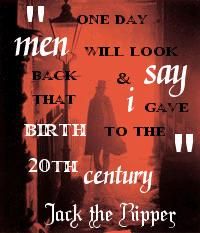
Jack the Ripper.............

Whitechapel Jack
I keep coming across new articles about another topic that fascinates me.  Jack the Ripper.  I know, I can't really explain it, I am intrigued by this infamous serial killer from the past, and I am not the only one. There are groups of amateur sleuths, Ripper historians, and Ripperologist who study Ripperology and Ripper Diaries nonstop.

Who was this maniac who mutilated and murdered a number of women in London's East End?  The bogeyman?  Hardly!

All signs point to Jack the Ripper but who is he? Is he a myth or a real person or multiple people?  Are the tales just pseudohistory or folklore?  And why the name Jack the Ripper?  This is what I found.

London, Whitechapel in the late 1880s.

The story says that "the first modern day serial killer" coined the name Jack the Ripper for himself in a letter written in 1888 known as the "Dear Boss letter."  It was sent to the Central News Agency and subsequently turned over to the Metropolitan Police Department a few days later.  It is also believed that any number of people could have been Jack the Ripper including one theory stating Jack was really Jill because it was believed at one point that Rosyln D'Onston was the Ripper (Jill the Ripper).

The true identity of Jack the Ripper (Whitechapel Jack) has not ever been 100% determined but recent DNA testing is pointing to a deranged Polish barber named Aaron Kosminkski.

Still others refuse this because Kosminkski did not fit the physical description of the Ripper.

Other possibilities besides Aaron Kosminkski, strange, Polish-Jew hairdresser in Whitechapel, are Prince Albert Victor Christian Edward, The Duke of Clarence, Francis Tumblety, American quack doctor born in Ireland, Rosyln (Robert) D'Onston, writer, George Chapman, a Polish surgeon/medical professional, Montague John Druitt, a school teacher, Walter Sickert, an eccentric, German, Impressionist painter, and Lewis Carroll (Charles Lutwidge Dodgson), the great English writer. What?

Over the decades at least 200 suspects have been named.  You have to remember that evaluating a crime scene during that time period was a lot different than crime scene evaluation methods we used today.  With today's methods, I am sure his identify would have been discovered with ease.

There were allegedly five brutal murders committed by Jack the Ripper between April 3, 1888 and February 13, 1891.  The canonical five victims (as they are called) are Mary Ann Nichols killed August 31, 1888; Annie Chapman killed September 8, 1888; Elizabeth Stride killed September 30, 1888; Catherine Eddowes killed September 30, 1888; and Mary Jane Kelly killed November 9, 1888.

Scotland Yard theorizes the idea that there were four other women murdered by Jack the Ripper just before April 3, 1888 and another on April 9, 1888 which would bring the total up to 9 murders.  Others believe the number of victims is over 11.

So the true identity of this serial killing lunatic of London's East End remains unknown.

He taunted the authorities with his handwritten letters and catch me if you can attitude.

He was never caught and there was much relief when the murders stopped in 1891 until another letter surfaced in 1896 which started the panic all over again.  Luckily the murders did not start again.

Oddly enough, one good thing did come of this.  The Ripper-killings brought attention to the poverty, disease, and famine in the East End and a few changes were made.

I hope at some point in time the identity of this obviously incurable mentally-deranged person will be known but if not, I do love a good mystery!

Great links for more info.
Going to London?  Take a Ripper tour.
Jack the Ripper Museum.
Find a grave, Jack's victims.
Huffington Post
Independent news UK
Express
Techly
SFGATE
AL

Thanks for horsing around with me. You really never know what you will get when you read my blog so thanks for stopping by.