Showing posts with label marine biology. Show all posts

Tuesday, June 28, 2016

For shark week. The most unusual shark in the world, drumroll..........

Mollisquama parini.

This shark belongs to the Dalatiidae family a.k.a. sleeper sharks.  Thirty-six years ago off the coast of Peru, the first of this species (a female) was discovered and at that point, the only one ever seen!
This first pocket shark is held in a museum in Russia.

Another of these rare species (a relatively young male) accidentally turned up in 2010 in a batch of fish that was collected off the shore of Louisiana while the study of what sperm whales eat was underway.

This little guy was literally discovered by accident in a bag of fish in a freezer.  These sharks are so unique not much is known about them.

Interesting facts about pocket sharks.
~The most interesting fact is probably that there have only ever been two discovered but scientist believe there are more out there.
~No one has ever seen a pocket shark alive and only a handful of people have seen the two that have been discovered.
~There are unusual photophore agglomerations (light-emitting organs) on their bellies that are not seen on the majority of sharks.
~This type of shark has a pocket gland with a large slit external opening which is located above the pectoral fin.  No one is certain what the purpose of these mysterious pockets are but the working hypothesis is that the pockets hold glowing fluid or pheromones which are secreted by the pocket sharks.  The fluid could be used to attract prey or mates and/or elude predators.
~The pockets are said to measure about 4% of the shark's entire body.
~It is believed that pocket sharks are bottom-dwellers.
~The closest relative to the pocket sharks are cookie-cutter sharks and the kitefin sharks.

As I said not much is known about these fascinating little creatures.  What is known is that they are simply amazing and adorable!

Read more here and here.

Happy shark week!

Wednesday, March 30, 2016

Apologia Biology Mod 10; Lesson on symbiosis.......

Symbiosis:  The word symbiosis comes from two Greek words; sym=together and bios-life.  Symbiosis is a biological relationship in which two species live close to each other and have interactions that will usually benefit both organisms but not always.

The four types of symbiosis include commensalism, parasitism, mutualism, and endosymbiosis/ectosymbiosis.

~Commensalism (one-sided) is a type of relationship in which one of the organisms benefits from the symbiosis while the other organism does not necessarily benefit but is not harmed from the relationship either.

~Parasitism is when one organism benefits from the relationship at the expense of the other-i.e. an organism might live inside the body of the other organism or on its surface.  This type of symbiosis can result in death for the host.

~Mutualism is symbiosis at its finest!  In this relationship, both organisms benefit and many will form long-lasting relationships.

Endosymbiosis is when one organism lives inside another and ectosymbiosis with when one organism lives on the surface of the other.

Apologia biology had more than a few interesting examples of symbiosis but this one by far was the most interesting to me.

The Oriental Sweetlips and the Blue-streaked cleaner wrasse are both fish.  One much larger than the other.  Many fish, like the Oriental Sweetlips have teeth.  Just like with humans, fish need to have their teeth cleaned.  That makes sense but how does that happen?  So it seems that the Blue-streaked cleaner wrasse will take care of that for the Oriental Sweetlips in return for a little protection.

After eating small fish all day, the Oriental Sweetlips will look around for a specific spot on the coral reef (cleaning station).  Then they just swim over to it, open their mouth, and Blue-streaked cleaner wrasse with willingly swim right into the Oriental Sweetlips' mouth and proceed to eat away all of the plaque right off their teeth.  So the Oriental Sweetlips get their teeth cleaned and provide protection for the Blue-streaked cleaner wrasse who benefits from the plaque (which is their food source).  Mutualism.........so nice!

Sunday, March 2, 2014

ShhhhhSharks!!!! and shark dissection!

Marine biology is a blast!!  Well maybe not a blast for the poor creatures that had to die so that students can
image from the web
learn science hands on.  Last week, we picked apart a sea star and this week, a shark!  I have to say, sharks have always been a fascination of mine.  I love sharks but I am not quite sure why, I just do!

First the classification of sharks.
Kingdom- Animalia
Phylum- Chordata
Class- Chondrichthyes -(cartilaginous fish)
Subclass- Elasmobranchii
Superorder- Selachimorpha

A few shark factoids:
~Did you know that until the 16th century, sharks were referred to as seadogs?
~Did you know that there are over 400 types of sharks?
~It has been estimated that at least 30 of those 400 types have attacked humans.
~Sharks have been around in some form for about 400 million years.
~Sharks are apex creatures (at the top of the food chain).
~Sharks can be as small as six inches and as large as 45 feet.
~Sharks can hear a fish swimming around in water from about 500 meters away.

Rotten shark from Iceland-image from the web.
~If you travel to Iceland, you may be offered an Icelandic Rotten Shark (Hakarl) as it is a traditional dish there.  Icelanders say it tastes like cheese.  Ugh!  Gag! There goes my love for cheese.  I will just take their word for it.  If you are not a fan of eating (cheesy) shark, you can go to Soloman Island in Fiji.  Eating sharks is forbidden there.
~It is estimated that 73 million sharks are killed each year for their fins. in order to make shark fin soup in Hawaii, Asia, and Australia.
~Did you know that sharks do not have bones?  They have cartilage instead.
Burton Post-Frilled shark
~The majority of sharks give birth to their young.  They are called pups.  Pups are born with the ability to take care of themselves right away.  Usually when they are born, they swim away as fast as they can so that the mother shark will not eat them.  There are a few species of sharks that lay eggs on the ocean floor.  The pups then hatch later on their own.
~Sharks swim practically all the time for their entire lives, they have to.  Swimming forces water over their gills so that oxygen will be delivered into the shark's blood stream.  A shark has to move continuously or it will suffocate and die.
~Great white sharks are said to be the deadliest sharks.  They can swim approximately 30 km per hour.  Great whites are warm-blooded.
image by  David Biesack-
Hammerhead


~Other highly dangerous sharks include the Tiger Shark, the Mako shark, the Bull shark, and the Hammerhead shark.
~The Tiger sharks are aggressive from birth.  The first pup to hatch (inside the mother's womb) will devour all the other pups but one.  That leaves one pup on each side of the womb.  That is cold!
~Sharks will never run out of teeth.  They have several rows of teeth so if one comes out, a new one will move into its place.
image by Kelvin Aitken-
Ghost shark


~Sharks have a keen sense of smell.  It is thought that a shark can smell one single drop of blood in 1 million drops of water.
~Sharks may be colorblind, although they seem to be able to see the color yellow and have been known to attack if they see it.  Probably a good idea not to have a yellow bathing suit.
~Sharks do get a bad wrap.  You are more likely to die from being struck by lightening or drowning than get attacked by a shark.
~The movie Jaws was based on a true story.  In 1916, four people were attacked off the coastline of New Jersey.
image by 
Dianne Bray Australia
-Goblin shark
~An excessive fear of sharks is known as galeophobia.  The word galeos is Greek for a certain type of shark.

~Sharks can detect electrical fields.


Our specimen was a dogfish shark.  You can read more about the dogfish shark here.  A brief description:  There are around 119 different species in the dogfish shark family.  They range from 6 inches to 45 feet long.  Their pups are born live from the mother's body, they can live in cool waters or deep tropical waters, and many are bio-luminescent (an animal or organism that has the ability to produce light from a chemical reaction-another example-a jellyfish).
Finally to the dissection (hack job) that we did.

This is our poor little dogfish shark specimen.  
The belly side.  We concluded that this is a female.
This is C14 slicing the shark open like a pro and getting it ready to dissect. 
After the insides were removed.
The inside!  
This photo and the next photo are of the intestines which are full of poo at the moment.  

This is the tail section, cut open to show cartilage.
I love my purple "Dr. Oz-style" gloves.  This is a shot of the teeth.
This dogfish's mouth was very stiff and hard to pull open.
Finally after about an hour and showing it to a few neighbors, we laid the poor thing to rest.  I would call this blogpost a very brief summary of these fascinating creatures. 


Sunday, February 23, 2014

Marine biology: Sea stars (starfish).

This diagram is from Wiki -Asterias diagram 1 Pyloric stomach 2 Intestine 3 Rectal gland 4 Stone canal 5 Madreporite 6 Pyloric duct 7 Pyloric cecum 8 Cardiac stomach 9 Gonad 10 Ambulacral plates 11 Ampullae
image from Pinterest
~Sea stars, commonly called Starfish are not really fish at all.  Fish have gills, scales, and fins and sea stars do
not.  Sea stars also move differently than fish do.  Sea stars have tiny tube feet which helps them move.  They belong in the phylum Echinodermata which  simply means spiny skin. 

~This phylum includes sea urchins, sea cucumbers, and sand dollars.  Sea stars can vary in colors including blue, red, yellow, orange, and purple, and they can also vary in shapes and sizes.  

sunflower starfish-image from the web
~For the most part, sea stars have five arm-like limbs that extend outward making them resemble a star.  There are, however, a few sea stars that have more limbs like the twently-rayed sunflower star.  These sunflower starfish can have up to 40 limbs.  Youtube video of a sunflower starfish.

~Did you know if a sea star loses a limb, it can regenerate?  Yep, if one breaks off another will grow in its place.  This is helpful if the sea star is being threatened by a predator.  The majority of their organs are also in their arms.  

~Sea stars do not have blood.  Instead sea stars have a water vascular system which allows them to pump sea water through its sieve plate into its tube feet.

~sea stars have two stomachs.
~a cardiac stomach eats the food outside of the sea star's body and the food is then transferred to the pyloric stomach.
~sea stars eat bivalves such as clams and mussels. They also eat snails, barnacles, and small fish.
~sea stars have microscopic eyes at the end of each limb.
~sea stars can change their gender, when it is time to lay eggs, a male sea star can turn into a female sea star and lay eggs to increase their population.  A sea star can lay up to one million eggs at a time.
~sea stars are brainless-(some humans are too so not big deal).
~if a sea star gets cut, each piece can become a new sea star.

~a few different types of sea stars:
*Common starfish
*Horned starfish
*Blue starfish
*Ochre starfish
*Carpet starfish
*Eleven-armed starfish
*Chocolate chip starfish
*Comb starfish

~We attempted this dissection with the sea star in our kit, and I have to say, these little guys are a lot different than I had imagined them to be on the inside.
Our dissection pics.

The specimen-stinks!


The instructions said to cut one of the limbs off and open it up. 

Another shot of the amputated limb.

This is a shot after the limb amputation.  This is the underside of the sea star cut open.
I have to say again, this dissection was interesting.  I was expecting something completely different.  The insides of the sea star were soft and the internal structure looked very complex.  Interesting!

Friday, February 7, 2014

Clam dissection

We have dissected many things but this one was the weirdest.

A clam is a bivalve molluscs that usually lives buried in sand/mud.  The shell of a clam is fastened together at the back by a hinge-like ligament.  A clam has two muscles, one on each side that opens and closes the shell. Clams do have hearts and blood vessels.  Molluscs like clams have an open circulatory system-i.e. their organs are surrounded by watery blood which contains oxygen and nutrients for the clam.  Clams filter feed which means they draw in water containing food such as plankton and filter out the water through their gills.  Clams can live up to 40 years.  I know some people eat clams but ................I am so glad we do not, especially after seeing the inside of it and feeling the thick, tough muscle texture.  Now for the dissection.

Of course, we went outside.  We had everything ready to go, and we were following the step by step instructions-the first step was to simply open the clam.  This was a little more difficult than we anticipated.  The ligament holding the two shell parts together is very strong.  We thought it would just pop open but no.


Here is our science book, the packaged clam (stinks) magnifying glasses, dissection tools.
Stinky clam.

We ended up having to use a hammer to get the darn thing open so one side of the shell broke.

This is the inside of the clam.  The lining, the foot, and the muscles that open and close the clam.

A better shot of the muscles on the sides.
So that is it!  Wham, bam, thank you, clam!  Clam dissection-done!  I linked a youtube video below if you want to watch a clam dissection.

HS Biology
National Geographic
Find Fast Facts
youtube video

Thursday, February 6, 2014

Sea sponges-Phylum Porifera (porous)

~Did you know that a sea sponge is an animal?  They do not have a brain, other organs, or a heart but they are still classified as animals.

~They can also reproduce.

~They are considered to be hermaphrodites.

~The sea sponge is a primordial (original) animal.

~They have lived on earth for around 500 million years.

~Sponges can grow up to 10 feet wide.

~Sea sponges can live 9000 feet down in the ocean where sunlight never reaches.

~There are around 5000 species of sponges.

~They eat by filtering plankton and other organic materials through their pores.

~A few species of sponges are carnivorous.

~A sponge can regrow itself.

~The can live to be 200 years old.

~It is also believed that the ancient Greeks and Romans used sponges to pad their helmets to soften the blows by their enemies.

Pretty interesting information.  A sea sponge was part of the dissection kit that C14 got with the marine biology course.  She did the experiment which included cutting the sponge and making observations and illustrations of what she saw.  Even though this sponge has been preserved for science, A12 wanted to see if we could put it in salt water and regenerate it.  We will see what happens.  The other half went in the hermit crab tank as C14 did not want to simply throw it away.  I am surprised they did not ask to bury it in the yard with the other critters.  Only my kids!

Wiki
BBC
Enchanted learning

Sunday, January 26, 2014

The first four kingdoms-unicellular life (bacteria)

Continuing on with our marine biology study.  Here is what we learned.

picture from the web
Kingdom Monera-this kingdom, consists of unicellular (Prokaryotic-single-cell) life, represents the least complex organism-i.e. these organisms are the most simplistic form of life and may be related to other lifeforms from the distant past.

These single-celled forms of life can act like plants or animals. There are two groups (phyla) which are autotrophs (which are able to create their own food) and heterotrophs (which cannot create their own food).  The heterotrophs depend on the autotrophs.  Bacteria are placed in the Monera Kingdom as they are considered the oldest lifeforms on earth by (many) scientists.

Factoids about bacteria that you probably wish you did not know.

~bacteria are alive!
~Approximately one-third of all bottled drinking water (in the USA) are contaminated with bacteria.
~Did you know there is more bacteria in your mouth than there are people in the world?  Even if you have good oral hygiene, there are still anywhere between 1,000 to 100,000 bacteria on each tooth.
~Did you know there are 1,458 species of new bacteria in your bellybutton?
~bacteria double their numbers every 20 minutes.
~one drop of water can contain as many as 50,000 million bacteria.

Pretty gross and interesting.

Next up, Kingdom Protista.
picture from the web

Read more about bacteria here and here.


Sunday, January 5, 2014

High school science-marine biology.

We have been so busy with our world geography study, I have not had a chance to blog any of our marine biology study that C14 is working on for 9th grade.  Biology would have been a better place to start 9th grade but she has already had a lot of biology through other years so we decided to go ahead and see what happens, so far, so good.

The first few chapters are about the earth and oceans and the basics, just to make sure by the time you get to chapter 4+, it will be a little easier.  Then the fun starts with the dissections.  Here is just a bit of what we have covered so far.

*A few factoids:
~Scientists have named and classified over 1.5 million marine species, and there are an undetermined number of marine species yet to be discovered and named.
~Between 50% and 80% of life on earth is found in the ocean.
~Around 90% of volcanic activity occurs in the oceans.
~One mouthful of seawater can contain millions of bacterial cells, hundreds of thousands of phytoplankton, and tens of thousands of zooplankton.
~The oceans cover 72% of the earth's surface.
~The speed of sound in water is estimated to be 1,435 m/sec.  This is approximately 5 times faster than the speed of sound in air.

from Ducksters.com
*Cell factoids:
~Without cells, there would be no life because all living things are composed of cells no matter if they are single-celled organisms or multi-celled organisms.
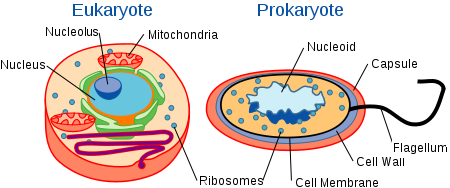
~There are two primary types of cells.  They are prokaryotic and eukaryotic.  Prokaryotic cells do not have a nucleus to house DNA but the eukaryotic cells do have nucleus that houses DNA.
~Archaens (microscopic organisms:single-celled) and bacteria are prokaryotic and animal and plant cells are eukaryotic.
~Did you know there could be as many as 100 trillion cells in the body?  Bacterial cells outnumber the human cells in the body.
~Parkaryotic cells are the most primitive form of life on earth, and they can thrive anywhere.
~Cells contain organelles which carry out functions for the cell.
~Groups of cells of the same type are called tissues.

More reading:
Science Daily
Science for kids
Biology for kids
Khan Academy

Okay, now I will go on about something awesome that was discovered while researching cells since that is what I like to do but this actually fits in with A12's study of DNA and life, either way, it is really interesting.  We found an article from the Smithsonian written in 2010 called Cracking the Code of the Human Genome.  This is the story of an African-American tobacco farmer named Henrietta Lacks.  In 1951, she was diagnosed with terminal cervical cancer.  She was treated at Johns Hopkins University by Dr. George Gey.  
 It turns out that Dr. Gey removed a few cells from her cervix without getting consent from Ms. Lacks, and he went on to make great discoveries from obtaining these cells.  Dr. Gey discovered that not only could Mrs. Lacks' cells be kept alive but the cells could also grow indefinitely.  Mrs. Lacks' cells have been cultured for the past 60 years and used in a variety of experiments such as a vaccination for Polio, in vitro fertilization, cloning, and genetic mapping.  These cells are called HeLa cells named after Mrs. Lacks.  They are cells from what is known as the immortalised cell line.  Mrs. Lacks' family, however, never knew anything about this until 25 years after she had passed away.  There is a book called The Immortal Life of Henrietta Lacks if you want to learn more.
Thanks for horsing around with me. You really never know what you will get when you read my blog so thanks for stopping by.