Showing posts with label dissection. Show all posts

Sunday, March 2, 2014

ShhhhhSharks!!!! and shark dissection!

Marine biology is a blast!!  Well maybe not a blast for the poor creatures that had to die so that students can
image from the web
learn science hands on.  Last week, we picked apart a sea star and this week, a shark!  I have to say, sharks have always been a fascination of mine.  I love sharks but I am not quite sure why, I just do!

First the classification of sharks.
Kingdom- Animalia
Phylum- Chordata
Class- Chondrichthyes -(cartilaginous fish)
Subclass- Elasmobranchii
Superorder- Selachimorpha

A few shark factoids:
~Did you know that until the 16th century, sharks were referred to as seadogs?
~Did you know that there are over 400 types of sharks?
~It has been estimated that at least 30 of those 400 types have attacked humans.
~Sharks have been around in some form for about 400 million years.
~Sharks are apex creatures (at the top of the food chain).
~Sharks can be as small as six inches and as large as 45 feet.
~Sharks can hear a fish swimming around in water from about 500 meters away.

Rotten shark from Iceland-image from the web.
~If you travel to Iceland, you may be offered an Icelandic Rotten Shark (Hakarl) as it is a traditional dish there.  Icelanders say it tastes like cheese.  Ugh!  Gag! There goes my love for cheese.  I will just take their word for it.  If you are not a fan of eating (cheesy) shark, you can go to Soloman Island in Fiji.  Eating sharks is forbidden there.
~It is estimated that 73 million sharks are killed each year for their fins. in order to make shark fin soup in Hawaii, Asia, and Australia.
~Did you know that sharks do not have bones?  They have cartilage instead.
Burton Post-Frilled shark
~The majority of sharks give birth to their young.  They are called pups.  Pups are born with the ability to take care of themselves right away.  Usually when they are born, they swim away as fast as they can so that the mother shark will not eat them.  There are a few species of sharks that lay eggs on the ocean floor.  The pups then hatch later on their own.
~Sharks swim practically all the time for their entire lives, they have to.  Swimming forces water over their gills so that oxygen will be delivered into the shark's blood stream.  A shark has to move continuously or it will suffocate and die.
~Great white sharks are said to be the deadliest sharks.  They can swim approximately 30 km per hour.  Great whites are warm-blooded.
image by  David Biesack-
Hammerhead


~Other highly dangerous sharks include the Tiger Shark, the Mako shark, the Bull shark, and the Hammerhead shark.
~The Tiger sharks are aggressive from birth.  The first pup to hatch (inside the mother's womb) will devour all the other pups but one.  That leaves one pup on each side of the womb.  That is cold!
~Sharks will never run out of teeth.  They have several rows of teeth so if one comes out, a new one will move into its place.
image by Kelvin Aitken-
Ghost shark


~Sharks have a keen sense of smell.  It is thought that a shark can smell one single drop of blood in 1 million drops of water.
~Sharks may be colorblind, although they seem to be able to see the color yellow and have been known to attack if they see it.  Probably a good idea not to have a yellow bathing suit.
~Sharks do get a bad wrap.  You are more likely to die from being struck by lightening or drowning than get attacked by a shark.
~The movie Jaws was based on a true story.  In 1916, four people were attacked off the coastline of New Jersey.
image by 
Dianne Bray Australia
-Goblin shark
~An excessive fear of sharks is known as galeophobia.  The word galeos is Greek for a certain type of shark.

~Sharks can detect electrical fields.


Our specimen was a dogfish shark.  You can read more about the dogfish shark here.  A brief description:  There are around 119 different species in the dogfish shark family.  They range from 6 inches to 45 feet long.  Their pups are born live from the mother's body, they can live in cool waters or deep tropical waters, and many are bio-luminescent (an animal or organism that has the ability to produce light from a chemical reaction-another example-a jellyfish).
Finally to the dissection (hack job) that we did.

This is our poor little dogfish shark specimen.  
The belly side.  We concluded that this is a female.
This is C14 slicing the shark open like a pro and getting it ready to dissect. 
After the insides were removed.
The inside!  
This photo and the next photo are of the intestines which are full of poo at the moment.  

This is the tail section, cut open to show cartilage.
I love my purple "Dr. Oz-style" gloves.  This is a shot of the teeth.
This dogfish's mouth was very stiff and hard to pull open.
Finally after about an hour and showing it to a few neighbors, we laid the poor thing to rest.  I would call this blogpost a very brief summary of these fascinating creatures. 


Sunday, February 23, 2014

Marine biology: Sea stars (starfish).

This diagram is from Wiki -Asterias diagram 1 Pyloric stomach 2 Intestine 3 Rectal gland 4 Stone canal 5 Madreporite 6 Pyloric duct 7 Pyloric cecum 8 Cardiac stomach 9 Gonad 10 Ambulacral plates 11 Ampullae
image from Pinterest
~Sea stars, commonly called Starfish are not really fish at all.  Fish have gills, scales, and fins and sea stars do
not.  Sea stars also move differently than fish do.  Sea stars have tiny tube feet which helps them move.  They belong in the phylum Echinodermata which  simply means spiny skin. 

~This phylum includes sea urchins, sea cucumbers, and sand dollars.  Sea stars can vary in colors including blue, red, yellow, orange, and purple, and they can also vary in shapes and sizes.  

sunflower starfish-image from the web
~For the most part, sea stars have five arm-like limbs that extend outward making them resemble a star.  There are, however, a few sea stars that have more limbs like the twently-rayed sunflower star.  These sunflower starfish can have up to 40 limbs.  Youtube video of a sunflower starfish.

~Did you know if a sea star loses a limb, it can regenerate?  Yep, if one breaks off another will grow in its place.  This is helpful if the sea star is being threatened by a predator.  The majority of their organs are also in their arms.  

~Sea stars do not have blood.  Instead sea stars have a water vascular system which allows them to pump sea water through its sieve plate into its tube feet.

~sea stars have two stomachs.
~a cardiac stomach eats the food outside of the sea star's body and the food is then transferred to the pyloric stomach.
~sea stars eat bivalves such as clams and mussels. They also eat snails, barnacles, and small fish.
~sea stars have microscopic eyes at the end of each limb.
~sea stars can change their gender, when it is time to lay eggs, a male sea star can turn into a female sea star and lay eggs to increase their population.  A sea star can lay up to one million eggs at a time.
~sea stars are brainless-(some humans are too so not big deal).
~if a sea star gets cut, each piece can become a new sea star.

~a few different types of sea stars:
*Common starfish
*Horned starfish
*Blue starfish
*Ochre starfish
*Carpet starfish
*Eleven-armed starfish
*Chocolate chip starfish
*Comb starfish

~We attempted this dissection with the sea star in our kit, and I have to say, these little guys are a lot different than I had imagined them to be on the inside.
Our dissection pics.

The specimen-stinks!


The instructions said to cut one of the limbs off and open it up. 

Another shot of the amputated limb.

This is a shot after the limb amputation.  This is the underside of the sea star cut open.
I have to say again, this dissection was interesting.  I was expecting something completely different.  The insides of the sea star were soft and the internal structure looked very complex.  Interesting!

Friday, February 7, 2014

Clam dissection

We have dissected many things but this one was the weirdest.

A clam is a bivalve molluscs that usually lives buried in sand/mud.  The shell of a clam is fastened together at the back by a hinge-like ligament.  A clam has two muscles, one on each side that opens and closes the shell. Clams do have hearts and blood vessels.  Molluscs like clams have an open circulatory system-i.e. their organs are surrounded by watery blood which contains oxygen and nutrients for the clam.  Clams filter feed which means they draw in water containing food such as plankton and filter out the water through their gills.  Clams can live up to 40 years.  I know some people eat clams but ................I am so glad we do not, especially after seeing the inside of it and feeling the thick, tough muscle texture.  Now for the dissection.

Of course, we went outside.  We had everything ready to go, and we were following the step by step instructions-the first step was to simply open the clam.  This was a little more difficult than we anticipated.  The ligament holding the two shell parts together is very strong.  We thought it would just pop open but no.


Here is our science book, the packaged clam (stinks) magnifying glasses, dissection tools.
Stinky clam.

We ended up having to use a hammer to get the darn thing open so one side of the shell broke.

This is the inside of the clam.  The lining, the foot, and the muscles that open and close the clam.

A better shot of the muscles on the sides.
So that is it!  Wham, bam, thank you, clam!  Clam dissection-done!  I linked a youtube video below if you want to watch a clam dissection.

HS Biology
National Geographic
Find Fast Facts
youtube video

Saturday, November 17, 2012

Flower dissection Apologia Botany

Usually when I hear the word dissection, I think of animals.  We have dissected a few unfortunate animals that did not make it to the other side of the road in time, a cow's eye when we were working on a Helen Keller unit study, and a frog for no real reason other than I picked it up from the homeschooling convention, and I figured since we were going to be cutting anyway and the frog was already dead, why not?  In case you missed those click here and here.

But this week, we dissected something different, a flower.  We just finished up lesson 3 in Apologia Botany.  So here is what a flower dissection looks like.

First you need to find a flower that looks similar to this flower.  Roses also work well for this dissection.
Turn your flower upside down and look for the green sepals.  The sepals protect the developing flower.  Together, the sepals are collectively called the calyx.
The sepals (calyx) have all been removed and the bud is now exposed.  All flowers have male and female parts but not the way humans do.
The next step was to remove all the petals which collectively are called the corolla.  This is a view of the bulb cut lengthwise in half to show the carpal or female part of the flower.  The carpal is attached to the center of the flower.

The little stalks that look similar are called the stamen.  These stamen are the male part of the flower.
Here is the notebooking page.  The various parts of the flowers that were dissected were glued into the appropriate section.  This is a great way to review what has been learned.
This dissection was really fun and educational!  It was also far less bloody, and there was no pungent odor as with the other dissections we have done.  You can find a co-op manual here that Mrs. Fulbright has provided for free if you are working with a group.

Saturday, April 23, 2011

Dissection!

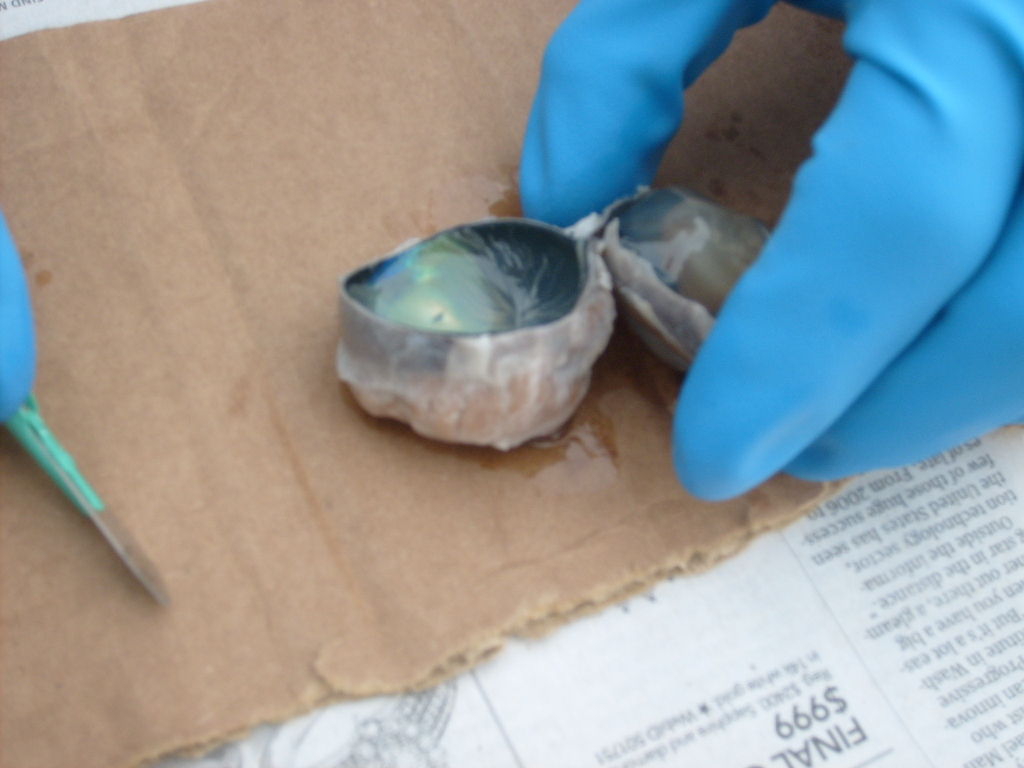
We are working our way through a biography of Helen Keller.  We are using our beloved Beyond Five in a Row as our guide.  Naturally, since Helen was blind, we took the opportunity to learn about the eye and seeing.  What eye study could be complete without the dissection of a cow's eye.

The following pictures are NOT for the faint of heart.

One cow's eye.

The cutting begins.
The principle cut the eye open.  The eye was full of vitreous humor.
Taking the poor cow's eye apart, piece by piece.
Dissection completed!  Here is a link to another dissection. 
Another great link:  here

We decided to do a frog dissection while we were at it. Helen Keller did not have a frog to my knowledge.  Again, not for the faint of heart.

This is the poor little frog who unknowingly gave his life to science.  RIP!
Cut, cut, cut!

The sound of ripping skin is disgusting!

A missing leg.

Inside.

This frog bites.
The rest of the pictures are just the guts and stuff.  You can tell, I am real scientific. 


Here  is a link to frog dissection. 

Overall, these were great science activities but I do not think we will be doing any more dissections anytime soon.
Thanks for horsing around with me. You really never know what you will get when you read my blog so thanks for stopping by.