Showing posts sorted by relevance for query egypt. Sort by date Show all posts

Sunday, October 5, 2014

Ancient Egypt

Let's go back about 5,000 years to ancient Egypt.  Round two with the ancients via Bob Jones University World History.
~Ancient Egypt was divided into three kingdoms; the old kingdom (3rd millennium BC-age of the pyramid builders), the middle kingdom (2000 BC and 1700 BC-12th dynasty), and the new kingdom (16th century BC and the 11th century BC).
~In the old kingdom, people considered the rulers as gods in human form.

~The most famous pharaoh of this time was Khufu; it was Khufu who built the Great Pyramid of Giza.

Great Pyramid of Giza
~Egypt sits in the northeast corner of Africa.

~Egypt is home to the Nile River.

~Nearly all Ancient Egyptians lived on the river banks.

~Ancient Egyptians used the Nile for many things including washing clothes, bathing, fishing, and drinking water.

~The Book of the Dead is a collection of papers written regarding preservation in the afterlife.  Read more here.

~Ancient Egyptians were ruled by pharaohs.

~Many things were invented in Ancient Egypt such as toothpaste, make up, pens, paper, keys, and locks.  It is also believed that the concept of wedding rings came from Ancient Egypt, and they were also great shipbuilders.

~Ancient Egyptians also invented Hieroglyphics.  Read more here.
~Ancient Egypt is synonymous for pyramids.  The Pyramid of Khufu is the oldest of the Ancient Wonders of the World.

~Most Egyptian Pyramids are located on the west bank of the Nile River.

~Ancient Egyptian pyramid builders were often paid in beer, about a gallon a day.

~Did you know that Ancient Egyptians loved board games?

~Cats were considered good luck in Ancient Egypt and some Egyptians were borderline obsessed with cats.  Cats were mummified when they died and buried in a cat cemetery.

~Ancient Egyptians were brilliant at math.

~Ancient Egyptians believed that they would be judged after death.  If they were good, they could count on going to a pleasant place but this was only if their bodies were well-preserved-i.e. embalming and mummification.

                                      Oh my gods!

~Ancient Egyptians worshiped over 1,400 gods and goddesses.

~Ancient Egyptians were also polytheistic (many gods).  They believed the rulers were gods, natural forces were gods, and animals, as well as the Nile River itself was believed to be a god.

~The main gods were as follows:
*Ra, the sun god.  Ra was the most important god with the body of a man with a head of a hawk with a headdress with a sun disk.  Ra created all forms of life.
*Isis, the mother goddess.  Isis would protect and help anyone in need.  She was a woman with a throne-shaped headdress.
Figurine of Horus
*Osiris, the ruler of the underworld.  Also the god of the dead.  He was married to Isis and father to Horus.  Pictured as a mummified man with a feathered headdress.
*Horus,god of the sky.  A man with the head of a hawk.
*Thoth, The god of knowledge and god of the moon.  He would bless the Egyptians with medicine, writings, and mathematics.  A man with an Ibis bird head but often represented as a baboon.

~And we are closing this study up with King Tut.  Probably the most famous known of the pharaohs.

~He became king around the age of 9 years old.

~He only reigned for about 10 years until his death.

~The cause of his death is still a mystery.  There are many theories ranging from murder, malaria, and being bitten by a hippopotamus.

~Born Tutankhamun around 1341 BC, died around 1323 BC.

Nefertiti
~Pharaoh Akhenaten was Tut's father and it is widely believed that Nefertiti (Akhenaten's first cousin) is Tut's mother.  Read more here.  Tut was born with a cleft palate and a club foot which is attributed to this relationship.  He was described as a frail, weak boy who walked with a cane.

~Marrying other family members in those days was not uncommon as they believed it would keep the royal bloodline pure.

~Tut married his father's daughter from another mother-i.e. his half sister (Ankhesenpaaten).  Tut and Ankhesenpaaten had no living children but Ankhesenpaaten had two miscarriages.  Found in Tut's tomb with him were the mummified bodies of two small female children, they are believed to be his daughters.

~Tut has no living heirs.

~King Tut's tomb in located in the Valley of the Kings, near Luxor, Egypt.

~The gold mask is made of 22 pounds of solid gold.


That is our second trip to Ancient Egypt.  This is one of my favorites of all civilizations.  So many interesting things to discover with new discoveries every day.  Next up the land of Canaan.
My other Egypt blog posts.
BBC
Egypt timeline
Pinterest
Find lesson plans and activities at PBS.
more lesson plan idea at Discovery Education.
More about King Tut here.
More King Tut here.
Take a quiz on King Tut's tomb here.

Wednesday, December 8, 2010

Ancient Egypt

This week we are working on Ancient Egypt.  We are using Evan-Moor Ancient Egypt pocket for this study.  I have carefully selected the topics so that we can make the most of this study.

 I decided to start off with Hieroglyphics.

This is from the Egypt pocket. 


 I found this potato hieroglyphic stamp idea on Jimmie's Collage and we gave it a try.  It was a little harder than we thought it would be but a lot of fun.

This is a picture of the slaughter of our potatoes.

I also used some of these premade cartouche forms  from Jimmie's Collage.  

Here are a few of the finished lessons that we have done so far.  We did the cartouche as described above, we used the Evan-Moor pocket and did reverse dictionary in which the kiddos had to use the hieroglyphic chart to solve the answer to a few questions, and we finished up with some Egyptian math, and I found out that no matter what language the math is in, my kids still hate math! 

Tuesday, January 4, 2011

Cleopatra, Queen of Egypt

We read a short biography about Cleopatra, simply titled Cleopatra.

A few factoids about Cleopatra:
*she was the last queen of ancient Egypt
*no one really knows what she looked like, she is sometimes shown with dark hair and sometimes shown with blond hair and light skin
*in ancient Egypt, a queen could not rule without a king so Cleopatra had to share power with her brothers or her oldest son
*Cleopatra was Greek not Egyptian
*legend has it that Cleopatra let a poisonous snake bite her, and she died shortly after
*Cleopatra ruled Egypt for 21 years

These are just a few facts that we found interesting.  Needless to say, Cleopatra was an interesting woman.  She is just as famous now as she was then. 

Tuesday, February 3, 2015

Early Civilizations--Africa

We are still making our way through the early civilizations, and we are now in Africa.  In general, I think everyone has heard a lot about Ancient Rome, Ancient Greece, and Ancient Egypt but not too much about Ancient Africa and yes, it is a thing.  So here is a little of what we learned.

Image of an Omo boy.
~It is believed that the human race is of African origin.  Skeletal remains that date back 195,000 years ago in Omo, Ethiopia (East Africa) are the oldest known skeletal remains to date.

~Africans used mummification over 9,000 years ago.

~Africa had many empires throughout history.

*The Kingdom of Ghana was under the rule of the first king, Dinga Cisse.  The word Ghana loosely translates to warrior king.  Ghana was rich in salt, gold, and iron.  In 1050 CE, the Ghana Empire began to feel pressure from the Muslims to convert to Islam but when the King of Ghana refused, they were constantly attacked.  Finally, the Ghana Empire fell apart and became part of the Mali Empire.

*The Mali Empire grew along the Niger River (Western Africa) and spread to the city of Gao to the Atlantic Ocean.  The Mali Empire was ruled by Sundiata Keita and was established in 1235 CE.  Mali flourished until around 1600 CE when it collapsed.
Songhai Empire
Image from Ducksters.

*The Songhai Empire was also located along the Niger River.  This empire lasted from 1464 to 1591.  Their leader was Sonni Ali, a prince of Songhai.  He was taken as a prisoner by the Mali Empire but he escaped in 1464.  Sonni Ali began to conquer all the nearby regions which included Timbuktu and Dejenne.

*The Kingdom of Kush was located in Northeastern Africa and south of Ancient Egypt.  The Kush Kingdom was located along the Nile River, the Blue Nile River, and the White Nile River.  This kingdom was established around 1070 BCE and lasted for about 1400 years.  The life span of the average person in the Kush Kingdom was between 20 and 25.  The priest had ultimate power, enough power to order the death of a king if they chose to do so.

*The Kingdom of Aksum, a.k.a. the Kingdom of Axum (Ancient Ethiopia).   This kingdom was located around the Red Sea in the Horn of Africa.  This kingdom lasted until around 940 CE when it was conquered by a queen from another region.

*The Kingdom of Zimbabwe took power around 1200 CE and lasted for more than 200 years.  This land in central Africa was covered with rainforests and grasslands.

click image for more
*Ancient Carthage, off the coast of the Mediterranean Sea, is present day Tunisia.

*Because of the diversity of all the people who settled in Ancient Africa, the religion, culture, art, and architecture was vastly different from place to place.

*It is believed that the earliest tools, the use of a tally system for counting, and how to start, use, and contain fire were all discoveries from Ancient Africa.


*We can also thank them for the process of tie dying
example of architecture-click image 
fabric.


Summing it up: Over the course of many, many years, Africa has seen the rise and the fall of several great civilizations and empires beginning with, of course, Ancient Egypt.  Check out my great links below.  See you at the next stop!
This is said to be a 20,000 year old
mathematical document.  Click for more.

More from my blog:
South Africa
Empires of West Africa
East Africa
Uganda 
Ancient Egypt
East Africa, Kenya
John Green-Mansa Musa and the spread of Islam in Africa.
Intro to African Art
Lesson plans from Mr. Donn
PBS

Thursday, December 30, 2010

More Ancient Egypt

I think we could spend years learning about Ancient Egypt and not cover it all but we are off to a good start.

Today, we learned a little more about mummification using Evan-Moor's History pockets "Where's my mummy?"  There are 3 layers to this project.  First, you wrap your mummy in gauze and then decorate the outer 2 layers of the sarcophagi.  Just in case you do not know what a sarcophagi is, it is the plural word for sarcophagus.  Here is the New World Encyclopedia's definition of sarcophagus:  A sarcophagus (plural:sarcophagi) is an above ground stone container for a coffin or dead body that often is decorated with art, inscriptions, and carvings.

This is A9's outer layer.
A9's second layer.
C11's outer layer.
C11's second layer.
I like how different they look.  My youngest daughter used dark colors and my oldest daughter used lighter colors.

A few factoids about the mummification process from the Evan-Moor Ancient Egypt History pocket.

This is the information sheet that we read.

*the process took 70 days
*the ceremony was conducted by 4 priests
*the inner organs were removed first
*the brain was removed through the nose and thrown away
*the liver, stomach, lungs, and intestines were removed through an incision made on the left side
*the heart was left in the body
*the organs were placed in canopic jars
*the body was washed with oils and spices
*linen and natron (sodium carbonate or salt) were packed into the body
*the body was then covered with natron and placed on a tilted slab
*the body dried for 40 days
*the old packing was removed and replaced and the incision sewed up
*the body was then rubbed with oils and resins
*the nostrils were plugged with wax
*make up was applied
*the first strips of cloth were wound around the body
*the process took about 15 days
*the body was decorated with jewelry
*good-luck charms were tucked into the 20 or so layers of linen strips
*the cloth-wrapped face was covered with a mask
*finally, the mummy was placed in one or more of the coffins and was ready for the funeral procession to its final  resting place

Well, there you have it!

Wednesday, December 17, 2014

Who doesn't love geometry? C15, that is who!

Or math, or algebra, or ....
I have this amazingly smart young lady that hates any kind of math and every kind of math.  She does not discriminate on the hate of math.  I am not sure why, she has always score well-over 90% but she hates it no matter what.

This year for tenth grade we are using Teaching Textbooks Geometry.  Traditional 10th grade geometry is Euclidean geometry. The section C15 is working on now is a direct tie in to her world history which is a great bonus even if she does not think so.

Who is Euclid and what is Euclidean geometry anyway?

~Euclid was born approximately 330 BC and died approximately 260 BC.

~Euclid, a Greek mathematician, is known as the Father of Geometry because of his revolutionary ideas, and his textbook called Elements which was written in the year 300 BC.  The word Euclid
click for image link
means good glory in Greek.

~It is thought that Euclid attended Plato's Academy in Athens prior to moving to Alexandria, Egypt.

~Geometry can be dated back to as far as ancient Egypt around 3000 BC.

~The word geometry means earth measure.

~Euclid wanted to prove that by using logic and reasoning, you could find out if things are true or not.  For example, the idea that all right angles are equal.  Euclid used logic and reasoning and prove that to be the case.

~Whether we like math or not, we still must learn it.  Geometry is a good math topic for C15 since she is a photographer.  The relationship between geometry and photography is an important one-i.e. aerial photography, photogammetry, depth perception, triangulation, and on and on.  Here is a free book called the Handbook of Aerial Photography if you want to learn more.

Click for image link


Monday, December 13, 2010

More on Ancient Eygpt

We were learning about pyramids today.  I bought this Egyptian pyramid kit from National Geographic so that we could explore a pyramid for ourselves.  Not quite the same thing but a fun way to spend half an hour.

I picked this up at Barnes and Noble with my discount card.
My kids could not wait for me to read the instructions, they just dove right in. 

This is part of the mess that we made during our excavation.

They managed to work the top of the pyramid off and then the fun began.  They worked together to chip away the sand inside the pyramid, and they found their mummy.

Inside is our mummy.


He looks kind of cold to me.
After they removed the mummy, they discovered that there were canopic jars inside as well.  Canopic Jars were used by the ancient Egyptian during the rituals of mummification processes. These were used as containers in which to hold the internal organs of the deceased that was going to be mummified.  The jackal  jar contained the stomach, the baboon jar contained the lungs, the falcon jar contained the intestines, and the human jar contained the liver.  We read in another book that they threw the brain away because they did not know what it was for.

These are really pretty and well made.
 This was a fun project to work on, and it just helped them understand a little more about mummies, pyramids, and archaeology.

We also worked on Pyramid Power from our Evan-Moor Egypt pocket.  We made a mini book that described the process of building a pyramid.  It outlines the process that was used to build pyramids all those years ago in a way that is simple to understand. 


It was a great day in Ancient Egypt for us.

Monday, December 6, 2010

Ancient civilizations

We are finally doing an in depth study of the ancient civilizations.  We will be using various materials as we make this journey into the past.  We will be using Evan-Moor history pockets as our core for this study.  Now, I have had a few people that have cautioned me on overdoing it with the pockets so I am carefully choosing which topics we will cover.

We started out with Evan-Moor History pockets for ancient civilizations and so far, so good.  Evan-Moor 
The first order of business was to review what history is and make sure we have a good idea what archaeology is before we continue the trip.

This is the cover.

This is the history pocket.   It gives a general outline of what history exactly is and some vocabulary words to learn.  The archaeology information is in this pocket as well.     

In the beginning of the history pocket is a map of the ancient worlds.  We will color these in as we make it to each destination.


Here are a few books that we used.


Next, we did a brief journey to Ancient Mesopotamia. 


This is obviously the Mesopotamia pocket.

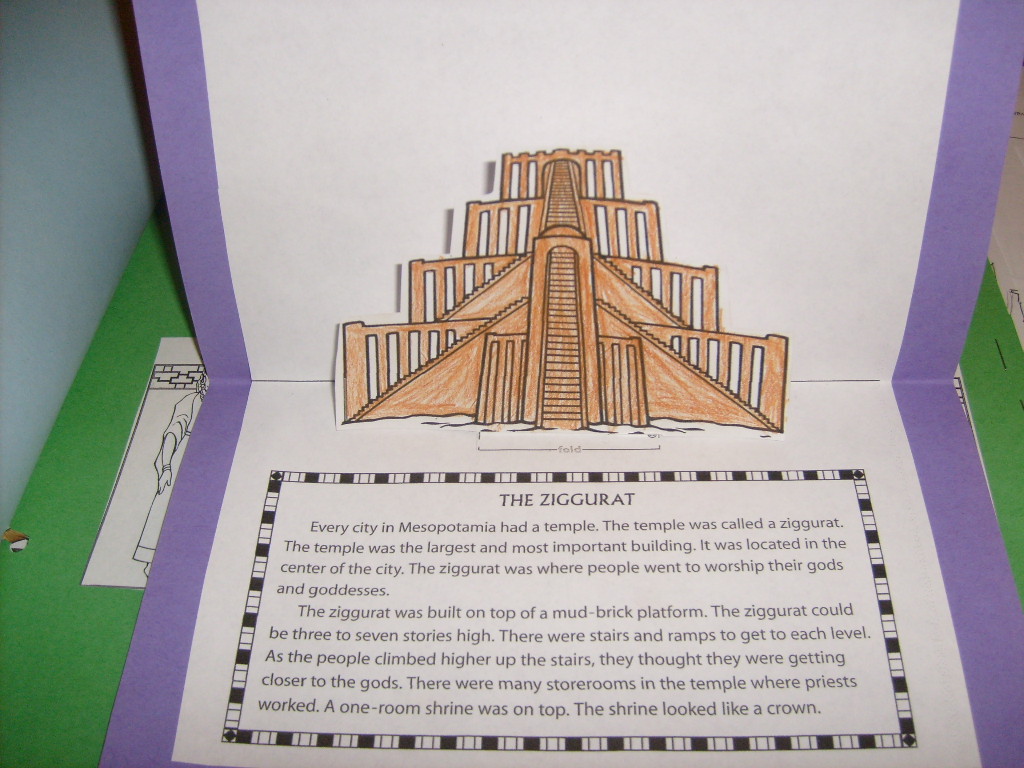
We made a Ziggurat pop-up book.

 We read the information that was included in this pocket but then we also look at lots of pictures,  read other books, watch DVDs, or find things on the internet that might be useful.

Two books we found especially helpful.

We will also be reading Story of the World volume 1 ancient times.  I do not consider myself a "Classical," teacher but this is very well written and just fun to read.

This was it for the first week of the ancient civilizations.  We will be starting Ancient Egypt using Evan-Moor Egypt pocket this week. 


Friday, December 31, 2010

Saturday, December 11, 2010

Books we read and DVDs about Ancient Egypt.

Here are a few books we have read and a DVD that we viewed for our Ancient Egypt study.


Friday, June 26, 2020

Capucchin Catacombs in Palermo, Italy....

My love for Italy and its history (the good, the bad, and the hauntingly mysterious continues) with part 2 of the catacombs where Rosalia Lombardo lays to rest; The Italian Girl with the Yellow Bow in Her Hair.

Photo source
So what is a catacomb anyway? The Ancient Romans constructed underground cemeteries consisting of subterranean galleries with recesses to entomb their dead.

The word catacomb comes from the Latin word catatubas which means among the tombs. 

This is one of those times teaching Latin in our homeschooling curriculum paid off.  Learning Latin is so under-rated.

I think everyone should learn Latin and Greek, emphasis on the base words at least.  Anyway....

Catacombs can be found all over the world including Salzburg, Egypt, Australia, Greece, Spain, Bosnia, and right here in the USA in Indianapolis; even though, traditionally, catacombs are more common in Rome and Paris.

No other catacombs in the world are quite like Catacombe dei Cappucini in Sicily.

Photo source
This cadaverous territory for the decomposing was created in the late part of the 16th century due to overcrowding at the Capuchin monastery cemetery.

In 1599, Silvestro of Gubbio was the first priest to claim a spot.

Photo source
Meet Silvestro
This oubliette of death was originally designed to be the forever home of the deceased religious men/monks; however when word got out that this vault of the dead could created a natural mummification process, everyone wanted in.

Securing a spot to immorality became a status symbol that only the wealthy could procure.  That helps to explain all the finely dressed mummies you can find there.  The dearly departed are essentially on display and a few are arranged in outlandish poses.

This catacomb is also divided into separate areas for the religious people, priests, children, families, professional men, and women.

There are also a few famous folks resting in peace with Rosalia including the son of a Tunisian king, Sicilian painter, Giuseppe Velasco, Colonel Enea DiGuiliano, sculptor, Lorenzo Marabitti, and surgeon Salvatore Manzella.
Photo source

If you find yourself in Sicily, you can hang out with these guys if you dare.


Affascinante!!
Here are a few additional links just for fun or if you ever decide to pay them a visit but don't bring your camera because they have currently banned anyone from taking pictures.  Luckily, there are plenty of pictures online.
Palermo Catacombs
Tripadvisor
The Wonders of Sicily (this is a great site)
Here is a short YouTube video to peek inside.

Friday, December 20, 2013

Mediterranean Europe-Greece

Another fantastically beautiful spot in Mediterranean Europe is Greece.

Officially known as the Hellenic Republic-in ancient times as Hellas is a beautiful country located in Southern Europe.  Greece has over 11 million residents.  Athens is the capital and the largest city in Greece.  The official language is Greek and Greece is a constitutional republic, parliamentary system.

factoids:
~If you are from Greece and are 18 or older, you must vote.  Not voting is not an option.

~The Olympic Games originated in Greece.

~Greece is almost 80% mountainous.

~Greece has more than 2,000 islands

~Greece has more goats than any other European country.

~Ancient Athenians were the first to develop a democracy.

~Greeks use more olive oil than anyone else.

~The Yo-Yo was invented 3,000 years ago in, you guessed it, Greece.

~Santa Claus is Greek~St. Nicholas was a wealthy Greek. He used to donate money to the poor.

~If you are going on a tour in the ancient part of Greece, high-heeled shoes are not allowed.  You will be asked to remove your shoes as not to damage any of the monuments.

~If you make it to Greece, it is not a good idea to dance naked in Acropolis-you will end up in jail if you do.


~The Greek alphabet has 24 letters.

~If a word has "ph" in it, it is most likely a Greek word.

~Greek is the foundation for many other languages (along with Latin).

~ my name in Greek.


~Aristotle Onassis
A few famous Greeks:
~Cleopatra (she was said to have Greek heritage but born in Egypt).
~Socrates
~Plato
~Aristotle
~Aesop
~Alexander the Great
~Telly Savalas
~Queen Sofia of Spain (She is married to the current King of Spain. We talked about him in our Spain study, King Juan Carlos I.)

~Homer


Acropolis


Of course, Greece has more than a few famous landmarks and monuments like the Acropolis of Athens which is home to a few architectural masterpieces, the sanctuary of Delphi, and Olympia just to name a few.


Like Italy, Greece has a fantastic list of  people.  There are too many to list.  You can read more at the link below.


National Geographic Greece 
More famous Greeks

Thanks for horsing around with me. You really never know what you will get when you read my blog so thanks for stopping by.