Showing posts sorted by relevance for query middle ages. Sort by date Show all posts

Sunday, January 25, 2015

Superstitions in the Middle Ages.

We are currently up to the point in our world history that we have found ourselves back in the Middle Ages.  I love the history surrounding this time.  We have covered this topic a few times before so this will probably be the last time for a formal study.

I thought it would be fun to tackle a few of the superstitions that can be related back to the Medieval Times.  This is what we found out.


~Have you ever wondered why someone might say bless you after you sneeze?  It might be because
back in the day, sneezing, a.k.a. little death, was the first sign of the plague so if you blessed a sneezer it might save them which ultimately it did not since history has it that only a few people actually survived the plague.

~If you lived in the Middle Ages, you better shut your door.  It was believed that if you left your door opened, the bad spirits would come into your house.

~They believed that if a cat walks in front of you, you would have bad luck and if the cat just happened to be black, you would have extra, extra bad luck.

~A bat in the house was a sign of death.

~If a person experienced a great horror, their hair will turn white.

~Begin a witch back then was not favored.  If a woman was accused of begin a witch, she was weighted down and thrown into a lake or river.  The point was to see if the woman would sink or rise to the surface.  If the woman rose to the surface, that was considered to be proof that she was indeed a witch.  If she sank to the bottom, the woman would be considered not to be a witch but at that point it would be irrelevant since she would have drown anyway.  Oh well, so much for that theory.

~Avoid bad luck by only stirring your pot clockwise.

~If the flame of a candle turns blue, chances are there is a spirit in the room.

~Were you born on Halloween?  If so, you have the gift of communication with the dead.

~Steer clear of any ladders.  Apparently criminals were hung from the top rung of a ladder.  The spirit of the criminal was believed to be lingering there and by walking under the ladder would be breaking the triangle of the Holy Trinity and one does not simply break the Holy Trinity.

~During the Middle Ages salt was believed to have medicinal properties and was very expensive, so expensive that some could not afford to have it so spilling salt was a big, big deal, and if you spilled it, you are evil.  When salt was spilled, it was customary for the evil-salt-spilling-person to throw the salt over his/her left shoulder.  Why?  To ward off evil, of course!  It was thought that by throwing salt over your left shoulder, it would get into the eyes of the evil spirits lurking behind you.

~A broken mirror is bad luck because a mirror represents an image of your soul so if you break a mirror it is believed that your soul has gone astray from your body.  You must also wait seven hours before you pick up the pieces at which point you need to go to the backyard and bury them under the moonlight.  That makes sense, right?

~Do not itch an itchy palm.  If your palm is itching, it means money is on the way unless you itch it, then it will not come.  Note to self, never itch palm again!

~If you take off your hat, do not put it on a bed, you guessed it, bad luck.

~Ever felt a chill up your spine?  It might be because someone just walked over your future grave.

~Many superstitions are for the birds, literally!

~A bird flying through your house is an indication of important news, however, if the bird cannot get out and dies, the news will be death.

~If a bird flies towards you, bad luck is heading your way.

~Crows were viewed as bad omens and are associated with death.  If you hear a caw, death is near.

~Sparrows were thought to carry the souls of the dead and killing a sparrow was considered back luck.

~If you see an owl during the day or if an owl, for whatever reason, looks in your window, bad luck and death are heading your way.

Believer or not, it is very interesting how things like this came to be.  While this type of information might not help you score high on an SAT, I think these types of things are fun to know.  So next time someone sneezes you will know why you are blessing them.

Monday, October 17, 2011

No Stress Chess

Our study of the middle ages has brought us a new favorite game.  I would not have thought that Chess would be a major source of entertainment in our busy house but I have been pleasantly surprised by the amount of time my kids (and myself) have spent playing this game. 

Chess was played throughout the middle ages and the rules were modified many times but generally have remained the same.  Fortunately for me, when I decided to add learning to play Chess to our middle ages activities, I found No Stress Chess.  This is such an easy way to learn how to play Chess. 

Basically, there is a set of cards which explains how each Chess piece functions.  For example, pawn, the first time a pawn is moved, it can be moved 2 spaces straight ahead but from then on that pawn may only move 1 space straight or diagonally.  The board also tells the starting location of each Chess piece.  How smart is that!  So, if you have no idea how to play, you simply pick a card and follow the instruction for the Chess piece.  After you catch on, you can flip the board over and play without cards.
 
Here are a few photos of the game itself.


No Stress Chess is one of the best games I have purchased.   I highly recommend it!

Now for a little background on the game Chess.  Some believe that Chess originated in China somewhere around the 2nd century B.C. and others believe its origin to be 6th century A. D. India then spreading to Persia and later into Southern Europe.

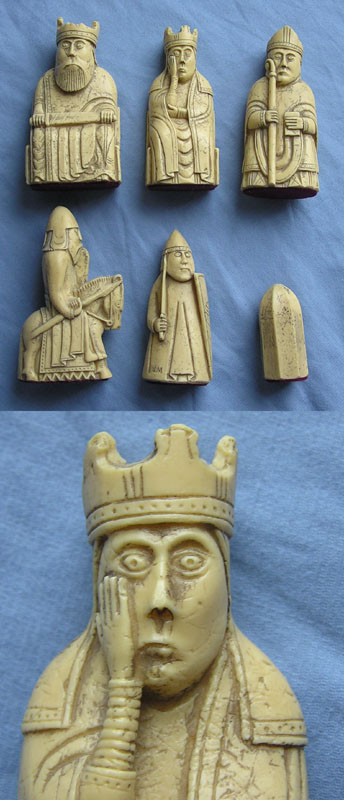
The game of Chess was also said to be popular with The Vikings.  The Vikings carved their Chess pieces out of walrus ivory and whales' teeth.  Below you can see a few of the original pieces called The Lewis Chessmen.
 
History of chess
Lewis chessmen-Wikipedia


File:Wfm lewis chessmen.jpg
pictures from Wikipedia
We have really enjoyed our new found game.  The game has been left out of the box and ready to play at a moments notice, and it has been played a lot! 

Tuesday, November 22, 2011

Renaissance wrap-up

We are finally nearing the end of the Middle Ages.  What a fascinating time period!  Full of plague, beheadings, and barbarians. 

The Renaissance began in Italy during the late middle ages.  Roughly from the 14th to the 17th century.  In a nutshell, the Renaissance or rebirth was all about rediscovering literature, art, philosophy, music, science,  and religion.  Humanism was also developed during the 14th century.

So, what did we cover?  A lot!  Italy, Florence, Venice, Renaissance artists and writers, science, alchemists, The Medici Family, inventions, patrons, Popes, architecture, Shakespeare, The Globe Theater, and explorers.

I am sure I am leaving a few things out.  This study could have easily taken a year or more but this is also a topic that will repeat itself in the high school days.  High school! GASP!  This is not too far awaaaaaaaaaaaaay!  

We will be taking a much needed break for the week of Thanksgiving and then we will be right back at it.  We will be working on a horse unit study which should be easy and fun since my kiddos are very horse-savvy. 

Wednesday, October 26, 2011

Medieval Times

We are moving on with our Medieval Times (also known as middle ages) study.  Here are a few resources that we will be using.

Beautiful notebook pages by Betsy Stout available at Currclick.  There are a lot of free printables on Betsy's Homeschool launch page.

Geography Through Art by Geography Matters.  We will use this for Coat of Arms and sketch a castle.

This is a card game in which you quiz the other players on their knowledge.  There is an easy level and a hard level.

This has turned out to be a great resource.

 Since we will be learning about castles, I thought I would incorporate a castle puzzle to work on together.  This is a beautiful castle called Neuschwanstein. 


Saturday, February 7, 2015

King Charlemagne: King of the Franks and the Holy Roman Emperor.

Trekking through the middle ages/medieval times with King Charlemagne a.k.a. Charles the Great.  We have learned a little about him before so we are going to recap that and learn some new things about this popular figure in history.
Charlemagne and Louis I, the Pious
 from wiki

~Charlemagne was the absolute sovereign ruler of the state and head of the church. The Holy Roman Emperor (Romanorum Imperator).

~He was born April 2, 742 CE of German descent.  His birth name was Carolus Magnus.  His father was Pepin the Short, yep, the Short, and was the king of the Franks in 751 CE.

~He was said to be over six feet tall with long blond hair.

~It is believed that Charlemagne was illiterate.

~Charlemagne is responsible for trial by jury.

~When Pepin died, Charlemagne and his younger brother, Carloman, ruled the Franks until Carloman died in 771 CE.

~Charlemagne did a lot of conquering and invading during his time.  Examples include wars with the Moors and the Saxon wars.

~A really important fact to note is that the only time in history France and Germany were united under the rule of Charlemagne.  France and Germany were briefly united for a few years under Napoleon's rule but never like when Charlemagne was ruling.

~On December 25, 800, Charlemagne was anointed emperor of the Romans (Holy Roman Emperor) by Pope Leo III after he crushed the rebellion in Rome.
Leo III-mosaic art from wiki

~Charlemagne passed away in Germany in 814 CE and his sole heir, Louis I, the Pious ruled until his death in 840.


~Charlemagne was married four times, he had 11 legitimate children with his second and third wives, and 9 illegitimate children with 5 random concubines (a woman who cohabits with a man she is not married to).

He must of learned this by example since his parents were not married when he was born making him illegitimate as well.

~Spouses include Luitgard, Fastrada, Hildegard of Savoy, and Desiderata of the Lombards.

~Children include Loius the Pious, Pepin the Hunchback (he had kyphosis hence the name hunchback), Pepin of Italy, Charles of Newustria, Rotrude, Drogo of Metz, Gisela, Theodrada, Bertha, Hugh, Hilitrude, Amaudru, Adalhaid, Richbod, Abbott of Saint-Riguier, Hildegarde, Theodoric, and Lothair.
I am not sure how he could remember all of this.

To sum it up, Charlemagne was an illiterate, illegitimate, woman crazy man who managed to accomplished so many great things that are very important in history.  He is said to be one of the most important king of all times.  You can find out more at the links below.

"Let my armies be the rocks and the trees and the birds in the sky."Charlemagne 742-814

Khan Academy videos part 1 and part 2.
History Channel. 
BBC
Biog

Wednesday, November 2, 2011

Ring Around the Rosie

Odd to think that a nursery rhyme about the bubonic plague would be a favorite of so many young children.  I remember playing and singing this when I was little but I never knew what it was about.  I liked the falling down part the best!  While studying the Middle Ages, we discovered the origins and meaning of the song.  Very interesting!

Ring around the Rosie-- refers to a red mark, supposedly the first sign of the plague.

A pocket full of posies-- people would put posies in their pockets to help cover the scent of death when they had the illness.

Ashes, ashes-- for the bodies that were burned (to ash) to stop the spread of infection. 

We all fall down-- Basically means death.  The Plague took victims who were rich or poor, young or old.

I am not a fan of the falling down part anymore!

Saturday, March 31, 2018

Easter: The (sweetest) oldest and most important Christian holiday....

Here are a few fun/random facts about Easter.

~The term Easter comes from Eastre, an Anglo-Saxon goddess who symbolizes the hare and the egg.

~Did you know that only 12 of the 50 states recognizes Good Friday as a holiday?

~In 2011 in Italy, the tallest chocolate Easter egg to date was created.  It weighed in a 7200 kg (15873.28 pounds).  Taller than a giraffe and heavier that an elephant.

~Pysanka which is the art of painting eggs originated in Ukraine.

~Easter eggs are considered to be a symbol of rebirth in many cultures.

~Where do you start when eating your chocolate Easter bunny?  In America, 76% stated they start with the ears.  Have you ever wondered why the larger chocolate bunnies are hollow?  Well, if they were not hollow, they would be as hard as a brick which would in turn break your teeth.

~Can you believe that over 700 million Peeps are sold in America every Easter?  In fact, Peeps are the most popular non-chocolate candy sold.  Before 1954, it took over 30 hours to make one batch of Peeps as they were hand-crafted and took hours to dry.  Today, that time is down to six minutes.

~Americans eat over 16 million jelly beans during the Easter holiday.

~Speaking of chocolate bunnies, over 90 million chocolate bunnies are produced in America each Easter, as well as 92 billion chocolate eggs, and Cadbury cranks out 1.5 million creme eggs each Easter.

~The Easter Bunny has apparently been hiding eggs since 1680.  He must be exhausted! 

~The idea of the Easter Bunny is said to date back to Germany during the Middle Ages.

Happy Easter

Thursday, March 12, 2020

Let's talk Friday the 13th....

Just like my ex.....

Friday the 13th has a bad reputation and has for countless numbers of years and with good reason.

I have done many posts about triskaidekaphobia because it is so interesting (not like my ex).  You can read those here, here, here, here, and here.

~This Friday the 13th is also coupled with a rare, full Harvest Moon.  The last Harvest Moon was 19 years ago and the next will not be until 2049.


~Basically, no one can pinpoint how far back this fear of 13 goes but it is estimated to be in the Middle Ages, even Hammurabi did not include law #13 in the ancient Code of Hammurabi.


~Did you know that in order for a month to have a Friday the 13th, the month must start on Sunday?


~It is hard to find a 13th floor in most high rise buildings and hospitals but if you try to test this theory, also look for room 13.


~Heavy metal band Black Sabbath's first album was released on Friday, February 13, 1970.


~Nasa predicts that a large asteroid will come close enough to Earth to be seen without a telescope in Asia, Europe, and Africa.


~Alfred Hitchcock was born on August 13, 1899.


~Tupac died on September 13, 1996.


~Have you wondered why there are 13 people at the Last Supper?


~Some people believe if you change your bed on Friday the 13th, you will have bad dreams.


~You may want to hold off on hair cut appointments because apparently getting your hair cut on Friday the 13th will result in the death of a family member.


If Friday the 13th causes you anxiety, you may want to avoid walking under ladders, black cats, broken mirrors,spilling salt, and getting your hair cut, even though the rational part of you knows it is just a bunch of hocus pocus.

Friday, September 13, 2019

Just like my ex.....

Friday the 13th has a bad reputation and has for countless numbers of years and with good reason.

I have done many posts about triskaidekaphobia because it is so interesting (not like my ex).  You can read those here, here, here, here, and here.

~This Friday the 13th is also coupled with a rare, full Harvest Moon.  The last Harvest Moon was 19 years ago and the next will not be until 2049. 


~Another interesting fact is that this Friday the 13th has fallen on a day with a palindrome pattern 9-13-19 (reads the same both forwards and backwards).


~Basically, no one can pinpoint how far back this fear of 13 goes but it is estimated to be in the Middle Ages, even Hammurabi did not include law #13 in the ancient Code of Hammurabi.


~Did you know that in order for a month to have a Friday the 13th, the month must start on Sunday?


~It is hard to find a 13th floor in most high rise buildings and hospitals but if you try to test this theory, also look for room 13.


~Heavy metal band Black Sabbath's first album was released on Friday, February 13, 1970.


~Nasa predicts that a large asteroid will come close enough to Earth to be seen without a telescope in Asia, Europe, and Africa.


~Alfred Hitchcock was born on August 13, 1899.


~Tupac died on September 13, 1996.


~Have you wondered why there are 13 people at the Last Supper?


~Some people believe if you change your bed on Friday the 13th, you will have bad dreams.


~You may want to hold off on hair cut appointments because apparently getting your hair cut on Friday the 13th will result in the death of a family member.


If Friday the 13th causes you anxiety, you may want to avoid walking under ladders, black cats, broken mirrors,spilling salt, and getting your hair cut, even though the rational part of you knows it is just a bunch of hocus pocus.

Tuesday, January 27, 2015

Its all about that plague!

Interesting facts about the plague/black death, the most feared disease of the ancient/medieval worlds.

~The plague a.k.a. black death was a terrible disease that spread throughout Europe from around 1347 until 1350.  Unfortunately, there was no cure for this terrible disease.  The plague was highly contagious and rarely did anyone with the plague survive it.

Skeletal remains near
the Tower of London
~Many believed that the plague was a punishment from God. (superstitions)

~Others believed that somehow pockets of bad air released during earthquakes was the case.

~Another notion was that the Jewish people were to blame.

~Symptoms included headache, vomiting, fever, swelling, pain, coughing up blood, and black spots on the legs, armpits, and chest.

~There was no cure for this rampant disease.  Oddly enough, people can still get this disease today but fortunately an antibiotic will take care of it.

~The origins of the plague are said to be from Asia with a westward movement along the Silk Road.  It is believed that the disease came from fleas that lived on rats that were living in the European merchant ships.

~By the time the disease had run its course, more than 200 million of the people in Europe were dead.  In France alone the estimation is over 800 people each day.

~Everyone was in such a panic, people would lock their doors and hide.

~There was no stopping the plague because rats were everywhere and the fleas were on the rats.  In an attempt to stop the plague, entire villages were burned down.

~It is estimated that it took the better of 150 years to rebuild Europe.

~The majority of folks wanted nothing to do with anyone that was sick.  In some instances, bodies of plague victims were catapulted over walls to infect enemies.  The only people who would see victims of the plague were doctors.  The brave docs would wear a mask with a nose which was around six
inches long and shaped like a beak.  Two air holes on either side were filled with aromatic substances to protect bad air from getting inside.  They would don a long coat, wear boots, pants, short-sleeved shirts, and protective gear over their eyes.

So that is the short version of the plague.  Check out the great links below for more plague-learning-fun!

My other blog posts regarding the middle ages, Medieval times, a few more.
History Channel-video, the coroner's report.
Mr. Donn

Thursday, September 15, 2011

Voyages of the Vikings

We are about to take an adventure to the Middle Ages to meet up with the Vikings.   The word Viking conjures up all kinds of images.  Images of pirates, raiders, explorers, and barbarians wearing horned-helmets.  For the most part, these images are correct minus the horned-helmets.  Historians believe that the horned-helmets depicted in most pictures would have been hazardous and cumbersome in the close-quarter style Viking combat.  Many Vikings were in fact dirty, crazy-haired pirates that took whatever they wanted from whomever they wanted whenever they wanted but many lived on farms raising pigs, sheep, goats, cattle, geese, and chickens.  They grew different kinds of grains and various types of vegetables.  The Vikings lived in long houses made from wood, stone, or blocks with thatched roofs.  Their clothing was simple.  Men wore tunics and trousers and women wore long dresses with aprons.  Vikings made their clothing from wool, linen, and animal skins.  (Information can be found here).

Here are a few books and other resources that I have found so far for our study.

I hope this will be enough. 
This is a simple, fun game I found to print off and play.  Mostly it was about the routes that the Vikings took during their explorations.  Great mapping skills.
BBC primary history-Vikings

resources for teaching

Viking Quest game

I also purchased Viking notebook pages from CurrClick produced by The Notebook Nook.

We are going to be learning about daily life, exploration, boats, weapons, and the places that the Vikings explored and discovered.

Saturday, October 29, 2011

Fabulous Medieval Times links and resources

I have found a wealth of helpful websites and resources for the Medieval Times so I thought I would share them all together in one blog post.  So here they are. 

You can design a coat of arms here and here.

Have fun with online jousting.

A unit study.

Life in the Medieval Times worksheets.

More notebooking pages from Notebooking2learn.  Just scroll down a bit.

The Door in the Wall unit study by Sheri.  She has a lot of great links.

Dynamic2moms have great lessons for Medieval Japan.
 
Middle ages for kids.

Make some parchment paper.

Find out about surnames and ancestry here.

Information on the black plague.

As you can see, there is a lot of great information for the study of the Medieval Times which makes it harder to narrow down what we should study and what we should save for later. 

Thursday, September 29, 2011

Voyages of the Vikings

We are about to take an adventure to the Middle Ages to meet up with the Vikings.   The word Viking conjures up all kinds of images.  Images of pirates, raiders, explorers, and barbarians wearing horned-helmets.  For the most part, these images are correct minus the horned-helmets.  Historians believe that the horned-helmets depicted in most pictures would have been hazardous and cumbersome in the close-quarter style Viking combat.  Many Vikings were in fact dirty, crazy-haired pirates that took whatever they wanted from whomever they wanted whenever they wanted but many lived on farms raising pigs, sheep, goats, cattle, geese, and chickens.  They grew different kinds of grains and various types of vegetables.  The Vikings lived in long houses made from wood, stone, or blocks with thatched roofs.  Their clothing was simple.  Men wore tunics and trousers and women wore long dresses with aprons.  Vikings made their clothing from wool, linen, and animal skins.  (Information can be found here).

Here are a few books and other resources that I have found so far for our study.

I hope this will be enough. 
This is a simple, fun game I found to print off and play.  Mostly it was about the routes that the Vikings took during their explorations.  Great mapping skills.
BBC primary history-Vikings

resources for teaching

Viking Quest game

I also purchased Viking notebook pages from CurrClick produced by The Notebook Nook.

We are going to be learning about daily life, exploration, boats, weapons, and the places that the Vikings explored and discovered.

Wednesday, April 30, 2014

Journey to Jordan.

نرحب إلى الأردن.

King Hussein of Jordan-
Image from Wiki
The middle east, first stop Jordan.
Jordan was first settled around 2000 B.C.  Jordan was settled and conquered by many different groups which include the Egyptians, the Israelites, the Babylonians, the Persians, the Assyrians, the Hittites, and of course, both the Greeks and Romans.  In 1516, Jordan was part of the Ottoman Empire and remained part of the Ottoman Empire until the end of World War I.  Jordan was then awarded to the United Kingdom.
Coats of arms of 
Jordan featuring the eagle

Factoids: 

*Jordan is a constitutional monarchy and King Abdullah II has been their ruler since 1999.  The official name is the Hashemite Kingdom of Jordan.

The Dead Sea-image from
twisted sifter


*King Hussein ruled Jordan for over 46 years making him the longest serving political leader in the world, ever! Upon his death at age 63, his oldest son Abdullah II ibn al-Hussein assumed title of King of Jordan.  Here is an interesting note, when using Arabic names, for exampl: Abdullah ibn al-Hussein, this is translated as Abdullah, son of Hussein.  They use the word ibn to indicate son of.  If this were a daughter, they would use the word bint to indicate daughter of.  An example, Dina bint 'Abdu'l-Hamid who was Hussein's first wife.  Dina daughter of 'Abdu'l-Hamid. Just a side note but very interesting and important for the culture.

http://country-facts.findthebest.com/l/186/Jordan
*The national name is Al-Mamaka al-Urduniya al-Hashimiyah.


*Amman is the capital.

*The currency is called the Jordanian Dinar.

*The Dead Sea is the lowest geographical point.  This is the world's saltiest sea at 33.7% salinity.

*The Eagle is their national symbol which symbolizes power, fortitude, and loftiness.

*More than 6 million people call Jordan home.

*The highest geographical point is Jabal Ram.

*Jordan is just a little smaller than Indiana.

*Jordan is mostly desert.

*90% of the Jordanians live on only 10% of the land.
Petra-ancient city carved in a mountain.

*Official language is Arabic but English is used among the upper and middles classes.

*Islam is the main religion in Jordan, specifically the Sunni-influenced Islam as 92% of Jordanians are Sunni Muslims.  Other religions include Christianity, Protestant, Greek Orthodox, and Roman Catholic.

*Jordan declared their independence from the United Kingdom on May 25, 1946.

*The Petra is the most visited tourist attraction in Jordan.

*The Jordanian cuisine is very vegetarian-friendly.


Nubian ibex
*Jordan has the lowest suicide rate in the world.

*In Jordan, legal age of consent is 16 and voting and drinking ages are both 18.


stripped hyena


*Jordan is home to a variety of interesting animals including the Nubian ibex, the stripped hyena, and at least 18 different species of bats. 

There is also a variety of beautiful birds in Jordan.  Click here for a complete list.
Spur-winged Plovers.


That wraps up our Journey to Jordan.  Next up the Caucasus which includes Russia, Georgia, Armenia, and Azerbaijan.

وداعا الآن-bye for now!

Read more:
National Geographic
More wildlife info
Famous folks from Jordan
Trivia for Jordan

Tuesday, July 7, 2015

Taking the mystery out of history with The Mystery of History volume 4.

The Mystery of History, how do I love thee?  Let me count the ways.

We are in our 11th year of homeschooling (gasp!) so I have been around the block and back with regards to curriculum more than a few times over the years.  I cannot say that I have used it or tried it all but pretty close to it.

No two homeschooling families are a like and certainly no two kids are a like.  Sometimes things work and somethings they tank during the first week.

Homeschooling is about loving to learn which can be difficult to do if your curriculum does not fit your kiddos and their learning styles or if it is too teacher-intensive.
Bright Ideas Press.
One curriculum that has not failed us is The Mystery of History.  (Well except when volume 4 was not printed and ready at the time we planned on using it but that is the worse thing The Mystery of History has brought us).

This curriculum will fit the majority of learners.

After we finished volume 3, I eagerly awaited volume 4 but we had to wait it out and use another curriculum last year but the good news is................I NOW HAVE THE MYSTERY OF HISTORY VOLUME 4!!!!!!!!! (happy dance)

I have already cracked this Modern Times volume open and read through half of it myself already.

Great attributes of The Mystery of History:

~It is well-written, extremely well-written!

~It can be used with all ages.

~It can be used independently with middle school and up as the book is written for the students.

~The lessons are relatively short but to the point.

~There is no guessing what comes next.

~Beautiful pictures throughout.

~Best of all, this curriculum can be tailored to fit the specific needs of your homeschool.  For example, when life happens and you just need to get what you can done and move on or when you need to ramp up the studies for older kids.
Cat-approved!
Volume 4 also comes with a CD you can just pop in your computer and print out what you need, i.e. maps, quizzes, etc.

Solve the history curriculum mystery today.  You can find The Mystery of History on Facebook, Twitter, Google plus, Youtube, MOH website, Bright Ideas Press, and you guessed it, Pinterest.  Please check this great curriculum!
Thanks for horsing around with me. You really never know what you will get when you read my blog so thanks for stopping by.